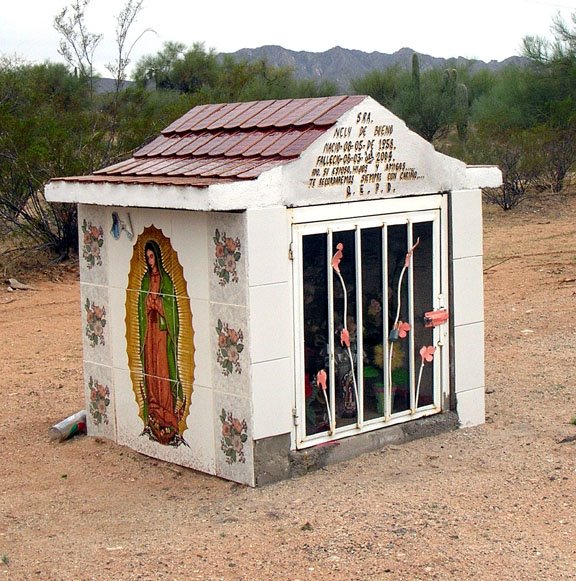
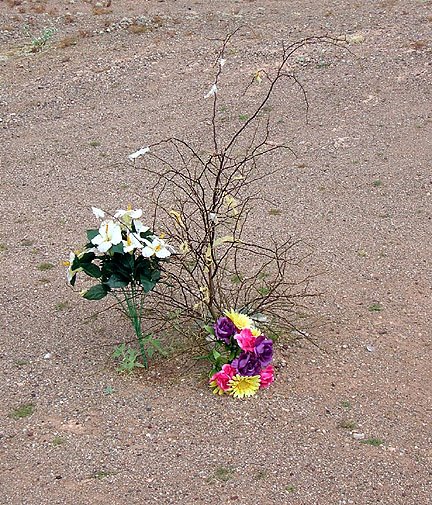
 Arizona desert landscape along the sides of the road. These public shrines, also called capillitas or grutas, have become Southwestern cultural icons. Part folk art and part expression of faith, they have evolved from the Spanish-Catholic traditions brought to the New World by early missionaries and settlers. Many mark the sites of fatal auto accidents and similar tragedies.
 On a recent road trip from Why, Arizona into Mexico, I could not help but notice the beauty of those shrines in the desert.
.
.
.
They ranged from the very simple to very elaborate and exhibit a tragic beauty of faith in folkart.
.
.
 Some of the shrines are simple crosses on the edge of the road, while others are more elaborate with candles, statues, artificial flowers surrounded by carefully raked sand.
.
.
.

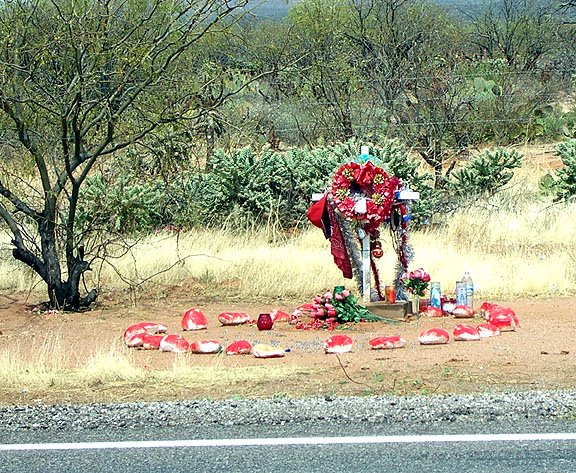 The straight flat highway through the Tohono O'odham Reservation is very monotonous. I noticed the shrines to others who also found it monotonous, and died along its straight shoulders. They appeared different from the ones I had seen before.
.
 The Tohono O'odham tribe is one of the few North American tribes never removed or relocated from its ancestral land. Once known as the Papago, the tribe officially changed its name to Tohono O'odham in 1986: "the Desert People Who Have Emerged from the Earth". Some archaeologists believe the O'odham are direct descendants of the Hohokam, who moved into the area about AD 200.